Sunday, March 20, 2011

Assignment #1 Photo Journal Part 2 - Press vs Art Photography

Press photography and art photography both have one sure thing in common. We are  looking through a camera lens trying to capture a moment of life. Using a camera and taking a photo with it is an art just by its self and it connects the two styles.   

Press Photography
Press photography is all about being accurate and following strict guidelines to ensure quality and truth when taking photos of news, sports and other events. They bring attention to something very important that happened in the world and they are usually published in magazines, newspapers and web sites.  These photographers often “specialise in particular field” (Barker) and can work for a company or as a free lancer. They need to have both creative and technical skills in order to bring the best out of the photo. These photos are not supposed to be atletered because that would be equal to writing a fake story. Press photography should focus on true events and to distribute untouched and real photos.

The first press photo was taken at a 2010 World Cup game between Germany and Serbia.  This photo of Serbian player scoring a winning goal traveled  around the world very fast and it made a big impact on people in Serbia. When they saw this photo they felt proud and happy which shows us how press photography keeps people informed and affects their mental state as well. A moment of life and history captured on the field thousands miles away from their country brought joy and happiness to the whole nation. If it wasn’t for the press photography who knows how and when they would find out about it.


In the second press photo we can see anti war protests from the 70’s. This image sends a clear message to the world and shows that not all U.S. citizens want their government to get involved in war in other countries. The power of press photo allows people to see the truth and have their own opinion.


Art Photography
Art photography is harder to define because it has a lot more freedom and it can be altered in order to make it look better. There are no real boundaries or guidelines as to what art photos are supposed to look like. It involves the vision of the photographers mind and setting up stage to detail it to the perfection. “fine art photography tends to have subject matter that focuses on natural elements, human forms, landscape, architecture and even dramatic images dealt with subtly and in fine detail.” (Kane).
In the first Art photo we have Eifel tower located in Paris, France. It is shown so small and as if someone was holding it in their hand. This vision of the photographer brings us up close and personal to the old French architecture. It is both art and press photography because it keeps us aware and informed of the advantages of visiting Paris while still showing us creativity and imagination.
The second art photo shows an old Coliseum in Rome, Italy. The beauty of this structure takes the viewer back in the days of the Roman Empire and connects art photography with historical events. This proves that art photos of the past can have a big impact in the future events. Someone seeing this artistic photo might wish to visit Rome sooner rather than later.


Works Cited

Barker, Caroline. "Press photographer: Job description and activities." August AGCAS 2010. Prospects the UK's official graduate career website. 19 03 2011 <http://ww2.prospects.ac.uk/p/types_of_job/press_photographer_job_description.jsp>.
Course Notes - Week 9. "Photojournalism - Course Notes Week (." (2011): Slide 8.
Kane, Dena. "Definition of Fine Art Photography." 1999-2011 Demand Media, Inc. www.ehow.com. 19 03 2011 <http://www.ehow.com/about_4886292_definition-fine-art-photography.html>.
Westbrook, Dillon. "Photography Schools - A Brief History of Photojournalism ." 2007. Photography Schools. 10 03 2011 <http://www.photography-schools.com/photojournalismhistory.htm>.
Photos:

Tuesday, March 15, 2011

Discussion #9 - Photojournalism


What's the role of photojournalism?
Journalism as a profession was very sensitive since the early days and the journalists had to be very creative to bring the picture to the readers of what really happened. This all came to an end once the photography entered the world of news and journalism. The information about wars, disasters and politicians was very accurate so people trusted this method of education. . “Consumers depend upon photojournalists to bring them the images that allow them to feel connected to far-away realities, and to be educated about those realities. (Westbrook) The images of the situation were so real and true that people started to respect photo journalism as a profession. 

Are there rules that a photojournalist should follow? Why? Why not? 
The rules of the photo journalism had to be implemented in order to keep various journalists play with the truth. Timeliness, accuracy, fair representation of the context of events and facts reported, and accountability to the public are some of the rules that are listed in the article “A Brief History of Photojournalism”.  The article also states: “A journalist, on the other hand, cannot be held to the demands of the photographic subject, but rather he or she must be concerned with producing accurate news for the public.” (Westbrook) It is crucial that these rules are followed together with not altering any photos, erasing people or objects.

Is the ethics of taking journalistic photos different than the ethics of writing a news story?
The ethics in any kind of profession are very important. The ethics for photo journalism are same as for journalism and they reflect on everyone so it could have a big negative or positive impact to so many different lives all over the world. In order for the truth to get out the code of ethics has to be strictly followed. The code from the reading says the only acceptable change in the photo is the quality of it. There can’t be any erasing of the people or objects (Course Notes - Week 9). As we all know technology today makes it easier to alter the photo so the ethics play even bigger role than before.


What's the impact of altering press photographs? Should they be edited (at all) in postproduction?
As I said above altering should only be done for the quality. Also you can’t take a photo and take something out of context. (Course Notes - Week 9) Taking a photo of a man behind barbed wire fence and distributing it as a photo from concentration camp could have huge consequences. What if the man was in fact free and he just happened to stand behind the fence.  I don’t see any difference between saying a lie or making a lie by altering a photo. I recommend the movie “Wag the dog”. Besides having my favourite actor Robert DeNiro, the movie is great because it shows us how one image could have the impact to start the war. It is scary that these things not only happen in Hollywood but also in real life.  If photo manipulation becomes part of photojournalism we have to fight against it with all of our power. We have to make sure the truth stays out there.


Works Cited
Course Notes - Week 9. "Photojournalism - Course Notes Week (." (2011): Slide 8.
Westbrook, Dillon. "Photography Schools - A Brief History of Photojournalism ." 2007. Photography Schools. 10 03 2011 <http://www.photography-schools.com/photojournalismhistory.htm>.


Photos:

Sunday, February 20, 2011

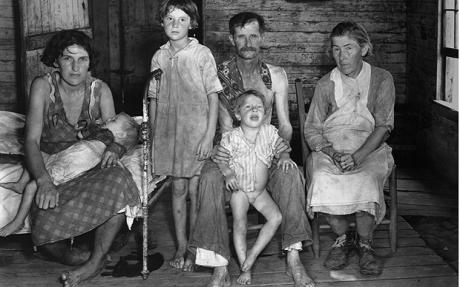
Discussion #6- Documenting the Great Depression

Destitute peapickers in California; a 32 year old mother of seven children [mother and two children on either side of her, children's backs to camera]
"Migrant Mother"

We often say that pictures speak thousand words. The impact the photographs of the Great Depression had on the society was a permanent one. It touched so many lives and placed photography into the center of attention for the rest of the eternity. It opened up the eyes of the ones who don’t know how it is to be hungry and gave hope to the hungry ones that they will not be forgotten. Working for the Farm Security Administration, Dorothea Lange made series of photos of a woman with a child which later became a famous and was called "Migrant Mother".                                                
 
"Great Depression Family"

This was a story about a woman who was barely surviving in the fields of the frozen vegetables eating birds killed by her children. She was very calm and did not mind the photographer taking photos from different angles. The woman was 32 years old and she just wanted her children to survive. There she sat in that lean- to tent with her children huddled around her, and seemed to know that my pictures might help her, and so she helped me. There was a sort of equality about it.”(The Library of Congress - Researchers) Dorothea said about meeting the “Migrant Mother". It seems as if the mother knew her story will be told and she was ready for anything. The impact these photos have today is as strong as the one fifty years ago. We can see sadness and struggle in her eyes, but willingness to make it is keeping her alive. It helps us understand what people in those days went through and how it all looked from the inside as well as from the outside.
Migrant agricultural worker's family. [mother with baby in lap, child behind her].
"Migrant Mother" #2

 Works Cited
The Library of Congress -Researchers. Prints and Photographs Reading Room. 22 10 2010. 14 02 2011 <http://www.loc.gov/rr/print/list/128_migm.html>.
Photos:
Photo #3: http://www.loc.gov/rr/print/list/128_migm.html

Assignment # 3- Photo Manipulation

It is very hard to have an original photo of someone when today’s technology allows us to change anything we don’t like about it. It is not enough that we take so many pictures to only choose few for the album; we have the opportunity to make them look even better. We can also cut and paste and be very creative making the photo into a piece of art. As we know from our readings, even in the early days of the photography, retouching was very popular. “Nadar, who was himself a journalist, sketch artist and caricaturist, sought to combine business with his artistic aspirations and on that account refused to resort to retouching, a practice that was extremely common at the time among photographers with more commercial preoccupations. In contrast, Louis and Ernest Mayer, who set up their joint company of Mayer Freres in 1850, specialised in the tinted portrait.” (Jean-Claude Lemagny) These kinds of companies are today replaced by Photoshop and other digital photography tools.
The first photo was taken in the park. I saw this tree which reminded me of some great beast standing over me. I took a photo and continued my journey. When we got this assignment, I started searching through my photos knowing that I could create something new. Since this photograph reminded me of an animal, I decided to make it into a Gorilla.For this photo I used the simplest program called Paint.  I cut and paste the head of the gorilla from another photo and I put it on the tree. I painted the empty space choosing the gorilla colour and then over that I sprayed some black. I used green spray to cover the background and make it seem more like a jungle. We can see how I was able to  be creative in two different ways. First way was creativity and imagination with a photo camera and second one was creativity with photo tools which alowed me to make it into unique piece of art.


Original Photo                                                               Edited Photo

In the other photo I used more simple approach and I changed it to look like a photo from 60’s. We can clearly see how something would look through the lens of the old cameras. Retouching of the photo is not always used with good intentions. People can be creative but send a negative message to the society. This is why we have to step up and spread the positive influence to the future generations who will be affected the most with the coming technology.  By using the simplest program for my first photo I proved  how in today’s technology any person who has the most basic computer skills can be creative and change the photo to their liking.


Works Cited
Jean-Claude Lemagny, Andre Rouille. The History of Photography. Cambridge: Cambridge University Press , October 30, 1987.

Photos:

Saturday, February 5, 2011

Discussion #3 Can art be mechanically reproduced?

Can art be mechanically reproduced? When something is reproduced for so many times is that art? What's the importance of the mechanical reproducibility of the art? What was the impact on mechanical reproducibility on the society?
Art is a unique creation of one person. It can be reproduced but only for the purpose of familiarizing the public with its beauty and elegance. Many books have photos of reproduced art in order to keep the future generations informed and up to date.  If it wasn’t for art reproducing we would not really know who were Picasso and Michelangelo and what did their work look like. The society was impacted and inspired by the famous artists and photographers so everyone tried to reproduce some kind of art on their own.


- Is photography art, or contribution to the art? Is it just a tool used by artists?
Photography is art especially with help of today’s technology. A photographer is able to take a photo and then use his imagination to add something creative or unique. Just like painters Photographers also use different objects or different set ups bringing the viewer up close and personal.  Different lens, shutter or focus is like painters different brushes, they bring different angles of the photography. Photographers live for photography and some of them even go as far as looking at everything through the lens of the camera.

- How and why Henry Pitch Robinson created Fading Away? What was the reason?
Henry’s photo of a girl dying tried to show how emotionally involved was her family. Using five negative and then combining them was an art which Henry created. He tried to show death through the eyes of regular people and how it affects them.  Photographers were using all of their creativity to make their photos even better and more real.

- Photography has impacted the world of art and influenced some changes in the area of accessibility to art. If mechanical reproduction created revolution, what is happening now with the digitalization?
Digitalization has brought reproduction and photography to a whole new level. Daily innovations and improvements are making it easier for us to reproduce old art or photos. This also allows us to create a memory for the next hundred years and to shoot, develop and post our photos faster and more efficiently. Digitalization also had a big impact on the photo industry in general. Customers rarely visit Photo studios because they are able to retouch their photo without professional help. This makes it very hard for some studios to stay in the business.  


Photos:

Assignment #1 Vintage Photography vs Modern Photography

A Painting-Self-Portrait in 1690's


Portrait of French painter Jean-François Millet (October 4, 1814 - January 20, 1875)
 Photography has been around way before 1850’s. For memory or an image to be created, we have to see first. That is how first portraits of famous people were transferred from the artist’s mind onto the painting.  From those paintings, the idea of photographs came and was born in mid 19th century. In New York, the method of transferring the image onto the glass was very popular and studio Mathew Brady was one of the many in who was offering luxurious portrait service to politicians, doctors, lawyers and others (Jean-Claude Lemagny).  The photographs also became very significant in Paris. They used a different method of photography which is transferring an image onto the paper. It was very popular and it cost 100 francs so a famous photographer Disderi was serving high class clientele of Europe. Another famous photographer Felix Nadar refused retouching any photographs so he hired specialists company Meyer Feyers for those kinds of photographs (Jean-Claude Lemagny). For that kind of special request today we use Photoshop.

Photographs are there to record a memory, an image or a moment in our lives.  Women like to pose, put on makeup or dress up, meanwhile men like to fix their hair or tie before taking the picture. All of them have the same goal, they are determined to look their best on the photographs and nothing can stop them. The things have not changed much today. We still take the photographs because of the same reasons, but now we can take thousands of them and choose the best one.  The difference is the way we take them, develop them and keep them and of course the technology has helped a lot in that department.

Technology allowed us to take these photographs and send them to our friends across the world in a matter of second after they have been taken. Photography was once considered profession but today everyone think they can be photographers. The view has certainly changed towards photography since the early days.  As much as I like digital photography and having a camera on my phone, I have to admit that with technological improvement we have lost that joy of anxiously waiting in front of a studio for the photos to be developed. Whether it was last night’s party or vacation, you really didn’t know how we turned out. Therefore it was a nice surprise when we open the envelope. Even the smell and the touch of the freshly developed photographs had a big significance for me. I also have to mention that black and white photographs are excellent for the portrait. Since there is not colour, our eye focuses more on the persons face and features and allows us to analyze the photo more detailed.  

We used to take photos to try and capture a moment or a frame of our life in a photograph but today with having many different options and taking many photos in few minutes it is more likely that we are trying to capture “the best possible moment”.

Paris in the early days of the Photography
Modern Photography

Works Cited

Jean-Claude Lemagny, Andre Rouille. The History of Photography. Cambridge: Cambridge University Press , October 30, 1987.

Photos:
1. http://www.oceansbridge.com/paintings/artists/p/puget_pierre/oil-big/self_portrait_in_old_age_1690_XX_muse_du_louvre_paris.jpg
2. http://www.google.ca/imgres
3. http://eaesthete.files.wordpress.com/2009/11/paris_style_02.jpg
4. http://www.sandrophoto.com/2007/11/24/photo-headers/

Activity #2-Who inspired me?Why?

My cat Cica :)


My First Camera
The introduction of photography not only amazed the crowd but it has also brought a new trend amongst the rich and famous. It wasn’t up to the artist anymore to transfer the image onto the painting. This image is real and it became so popular that everyone wanted to have one. For years and years we have been posing and the photography has improved. It is amazing how one click of the button can change person’s mood or state of mind. I was hooked on the photography at a very early age. My father has inspired me to take photos and guided me throughout my life as to how to properly take a photo and what to look for in a photo. For my 13th birthday, he gave me his old Yashica to practice and I was so happy that I spent three rolls of film in a week. My father was a professional cameraman for over 25 years. His passion for the photography and film and the experience showed me how to lead the life. I have chosen a different career path but photography will live inside me as long as I am alive.
My cat Sivka